OpenAI gpt-audio-1.5 vs BibiGPT in 2026: Which Audio API Should You Use for Podcasts and Long-Form Audio?
OpenAI gpt-audio-1.5 vs BibiGPT in 2026: Which Audio API Should You Use for Podcasts and Long-Form Audio?
OpenAI now positions gpt-audio-1.5 as its best voice model for audio-in/audio-out Chat Completions, unifying speech understanding and TTS in a single call. If you are building a short-turn voice agent, that is a great default. If your real goal is summarizing podcasts, handling hour-long audio, or shipping knowledge artifacts to Chinese-speaking users, BibiGPT already packages that as a product — with no engineering to assemble. This post compares both approaches based on OpenAI’s own documentation and gives you migration and hybrid patterns.
Table of Contents
- Quick Comparison: Positioning
- What gpt-audio-1.5 Can and Cannot Do
- Where BibiGPT Complements It on Podcasts and Long Audio
- API Migration Cost and Hybrid Patterns
- FAQ: gpt-audio-1.5 vs BibiGPT
Quick Comparison: Positioning
Core answer: OpenAI gpt-audio-1.5 is a general-purpose voice I/O model for developers building realtime or conversational voice agents. BibiGPT is a product for consumers and creators — long-form audio/video summarization, subtitle exports, mindmaps, AI rewrites, and multi-platform apps. They are not alternatives; they stack as “foundation model” and “end-to-end application”.
| Dimension | OpenAI gpt-audio-1.5 | BibiGPT |
|---|---|---|
| Positioning | General voice I/O model (audio input + output in Chat Completions) | AI audio/video assistant product for consumers and creators |
| Input length | Optimized for short-turn dialogue; long audio requires your own chunking | Handles 1+ hour podcasts, lectures, meetings out of the box |
| Chinese-market coverage | General-purpose; Chinese named-entity polishing is on you | Years of domain tuning for Chinese podcasts, Bilibili, lectures |
| Outputs | Text + speech response | Summaries, SRT subtitles, mindmaps, article rewrites, PPT, share posters |
| Engineering cost | You build ingestion, chunking, storage, UI, billing | Paste a link, upload a file, done |
| Pricing | Per-token / per-second API pricing | Subscription (Plus/Pro) + top-ups |
| Surfaces | Whatever you build | Web + desktop (macOS/Windows) + mobile + API + Agent Skill |
What gpt-audio-1.5 Can and Cannot Do
Core answer: Per OpenAI’s developer docs, gpt-audio-1.5 is the best voice model today for audio-in / audio-out Chat Completions, accepting audio input and returning audio or text in a single call. It is the natural pick for low-latency voice agents, translation assistants, and voice notes.
What it does well:
- End-to-end audio I/O — one call covers “listen → understand → answer → speak” without gluing STT + LLM + TTS yourself;
- Expressive TTS — according to OpenAI’s next-gen audio models announcement, the new TTS for the first time accepts “speak this way” instructions (e.g. “talk like a sympathetic customer-service agent”), enabling emotional voice experiences;
- Realtime voice agents — combined with gpt-realtime, it powers production-grade realtime voice conversations, barge-in, and role play (see OpenAI’s gpt-realtime announcement).
What it does not do (or requires you to build):
- Podcast / lecture / meeting knowledge artifacts — gpt-audio-1.5 is a general model; it does not hand you chaptered summaries + mindmap + clickable-timestamp transcripts;
- Link ingestion for YouTube / Bilibili / Apple Podcasts / Xiaoyuzhou / TikTok — parsing URLs, downloading, chunking and uploading are your engineering problem;
- Multilingual article rewrite, share cards, Xiaohongshu covers — product-layer capabilities, not API-level;
- Channel subscriptions, daily digests, cross-video search and other long-running operator features.
Where BibiGPT Complements It on Podcasts and Long Audio
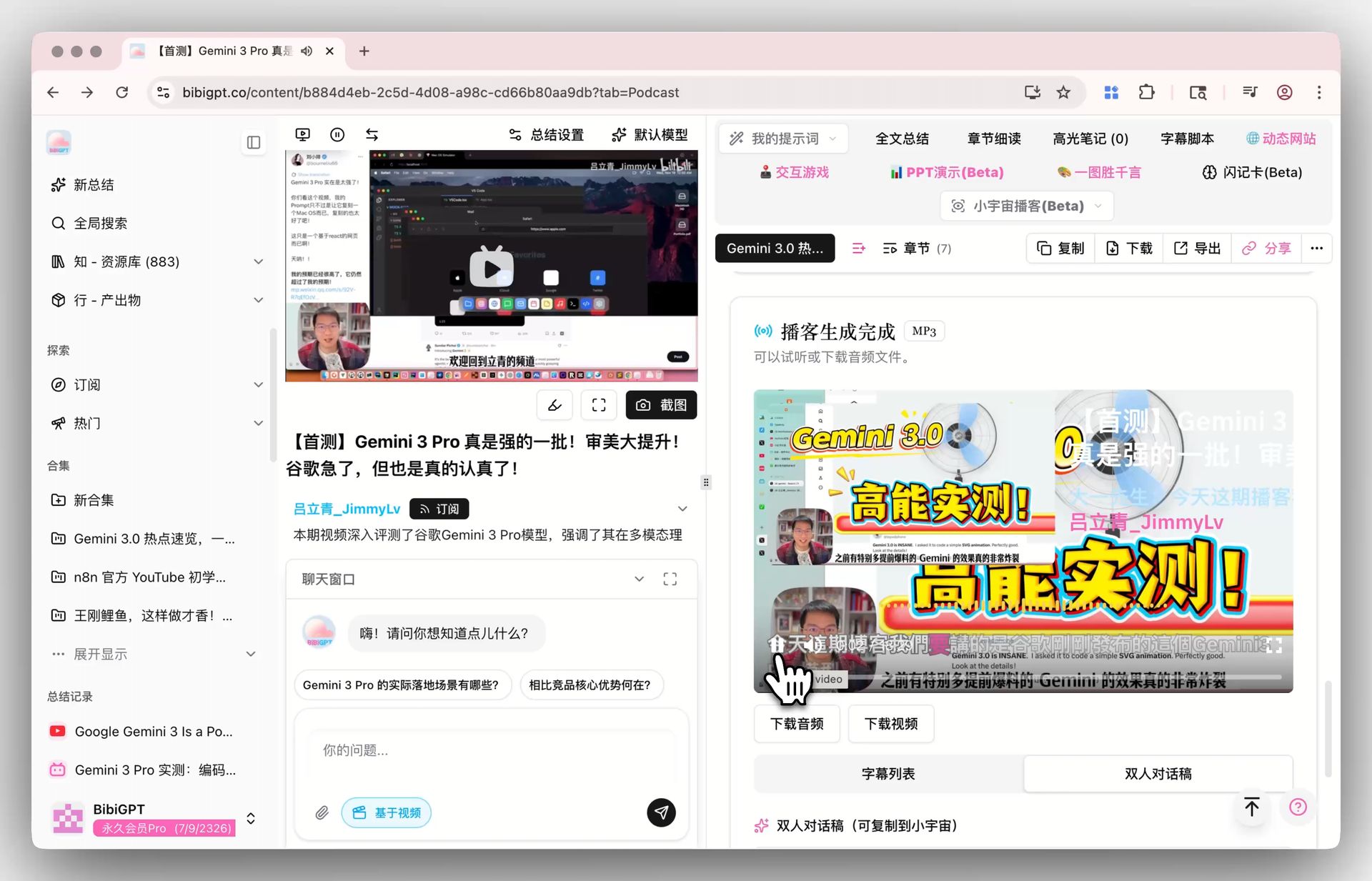
Core answer: BibiGPT ships long-audio understanding, artifact generation, and multi-surface distribution as an out-of-the-box product. Drop a podcast link, and in about 30 seconds you get a two-host dialogue-style podcast render, synced captions, and a structured summary.
Three capabilities where rolling a pure-API solution is expensive or impractical:
- Xiaoyuzhou podcast generation — turn any video into a Xiaoyuzhou-style two-host dialogue audio (voice combos like “Daiyi Xiansheng” and “Mizai Tongxue”), with synced captions, dialogue scripts, and subtitled video downloads. That is closer to a “content product” than any single-turn TTS call. Learn more → AI podcast transcription tools 2026.
- Pro-grade podcast transcription — pick between Whisper and top-tier ElevenLabs Scribe engines, with your own API key, for pro podcasts, academic talks, and industry interviews.
- Multi-surface workflow — the same audio can be highlighted, queried, exported to Notion/Obsidian, and pushed into downstream AI video-to-article or Xiaohongshu-style visual flows on web, desktop (macOS/Windows), and mobile.
API Migration Cost and Hybrid Patterns
Core answer: “Direct gpt-audio-1.5” and “BibiGPT” are complements, not competitors. Let BibiGPT own the audio-understanding-and-artifact layer, let gpt-audio-1.5 own the realtime conversation layer, and your cost and engineering load drop significantly.
Migration guidance for teams with an existing audio stack:
- Podcast / lecture summarization pipelines → switch to BibiGPT’s API and Agent Skill rather than maintain in-house chunking, ASR, summarization, mindmap, and article-rewrite subsystems;
- Voice agents, voice NPCs, voice input methods → keep OpenAI gpt-audio-1.5 + gpt-realtime; BibiGPT does not operate in that layer;
- Teams with both needs → gpt-audio-1.5 handles “listen to the user and respond instantly”; BibiGPT handles “listen to long content and produce knowledge artifacts”.
Cost framing:
- gpt-audio-1.5 bills by tokens/seconds — great for short, high-concurrency dialogues;
- BibiGPT bills via subscription + top-ups — great for long audio and high-value knowledge workflows;
- When your output is a “chaptered summary + downloadable SRT + share card”, BibiGPT ships all of it from a single action — consistently cheaper than stitching 3-5 APIs.
FAQ: gpt-audio-1.5 vs BibiGPT
Q1: Will gpt-audio-1.5 replace BibiGPT?
A: No. gpt-audio-1.5 is a developer-facing model at the I/O layer. BibiGPT is a product-layer platform for consumers and creators, covering discovery, summarization, repurposing, and cross-surface usage — and it can swap in stronger audio models underneath as needed.
Q2: Will BibiGPT adopt gpt-audio-1.5?
A: BibiGPT has long maintained a multi-vendor strategy (OpenAI, Gemini, Doubao, MiMo, etc.). If gpt-audio-1.5 proves clearly better on Chinese long-form audio and spoken podcasts, expect it to enter the selectable model list.
Q3: I just want “one podcast episode → timestamped transcript + summary” — what is the fastest path?
A: Paste the podcast URL into BibiGPT, wait 30-60 seconds, and you get a structured summary, SRT subtitles, and an interactive mindmap — no API code required.
Q4: Does gpt-audio-1.5 handle Chinese speech and dialects?
A: Per OpenAI’s docs, the gpt-audio family is multilingual; however, dialects and Chinese named-entity accuracy still warrant sample-based testing. For Chinese consumption scenarios, BibiGPT’s years of subtitle cleanup and named-entity lists give you a stronger baseline.
Q5: I am an Agent developer — how can I give my agent “watch video / listen to podcast” capability?
A: Check BibiGPT Agent Skill. It packages BibiGPT’s podcast/video understanding as Agent-native tools, so Claude/ChatGPT/others can go from “paste link” to “summary + subtitles” in one call.
Start your AI efficient learning journey now:
- 🌐 Official Website: https://aitodo.co
- 📱 Mobile Download: https://aitodo.co/app
- 💻 Desktop Download: https://aitodo.co/download/desktop
- ✨ Learn More Features: https://aitodo.co/features
BibiGPT Team